
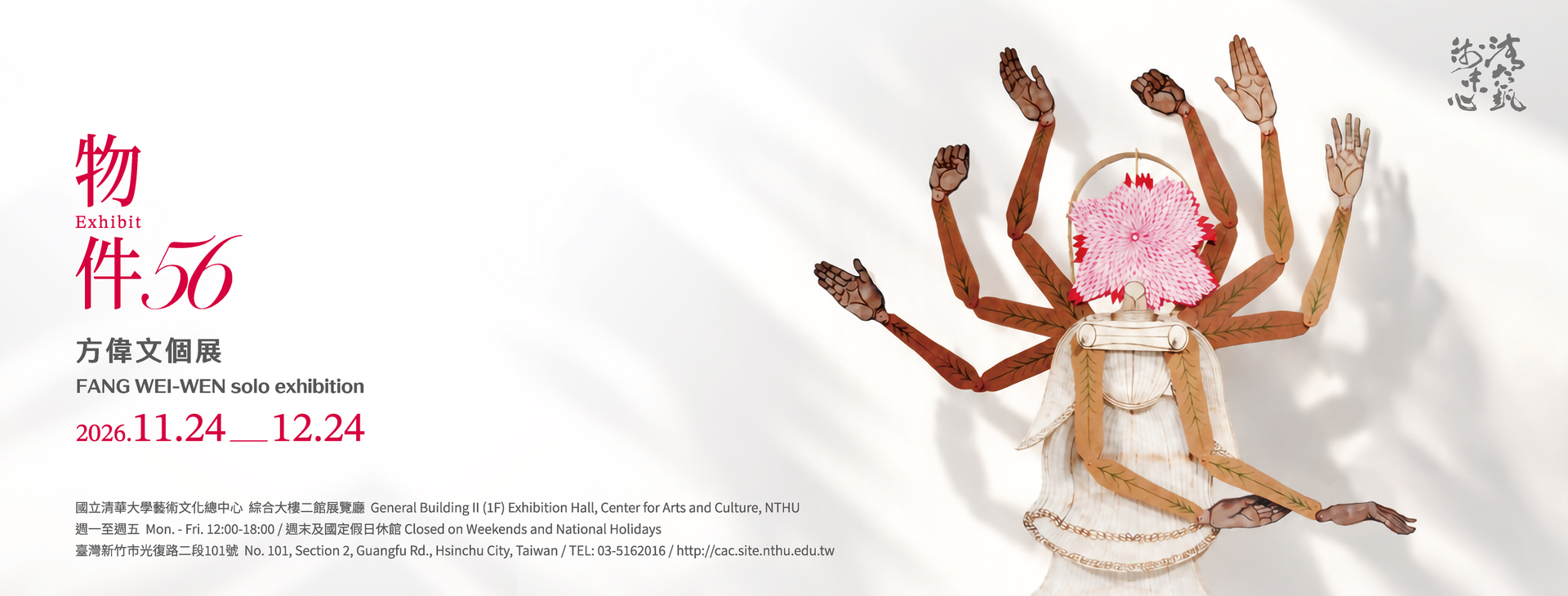
【物件56】方偉文個展 / “Exhibit 56” Fang Wei-Wen Solo Exhibition
展覽開幕
2026 / 11 / 24(二)16:30 ;同展覽地點 → 地圖

展覽期間
2026 / 11 / 24(二)—— 12 / 24(四)週一至週五 12:00-18:00,週末及國定假日休館
展覽地點
國立清華大學 藝文總中心綜二館展廳
展覽介紹
物件,既是生活中隨處可見的存在,也是記憶、經驗與時間的承載之物。對藝術家方偉文而言,物件不僅是創作的媒材,更是其長期藝術實踐中持續探索與對話的對象。自早期創作以來,方偉文便不斷嘗試突破繪畫的平面性,透過拾取、剪裁、拼貼、縫合與組裝等方式,將不同材質、圖像與符號重新編排,使作品游移於繪畫、雕塑與空間裝置之間,逐漸發展出獨特的「繪畫裝置」語言。
以自身年齡作為展覽命名,是方偉文持續以來的創作脈絡。「物件56」中的數字不僅標記時間的推移,也象徵著生命經驗的持續累積。那些看似尋常的材料、人物與文化符號,在藝術家的選擇與組構之下,逐漸脫離原有的功能與脈絡,形成新的形態與意義。不同事物之間的交會與重組,也如同生活中各種經驗的交錯,呈現出記憶與日常之間豐富而多變的關係。
在方偉文的創作中,物件不只是形式與材料的探索,更是個人經驗轉化為藝術語言的過程。透過長期的創作實踐,藝術家將對生活與周遭事物的觀察融入作品,使物件成為連結日常生活與生命歷程的另一種表達方式。
Opening
2026 / 11 / 24(Tue.)16:30 ;at the same venue → MAP
Exhibition Period
2026 / 11 / 24(Tue.)—— 12 / 24(Thu.)Mon-Fri 12:00-18:00, Closed on weekends & national holidays
Venue
General Building II (1F) Exhibition Hall, Center for Arts and Culture, NTHU
Exhibition Introduction
Objects are familiar presences in everyday life, yet they also carry memories, experiences, and traces of time. For artist Fang Wei-Wen, objects are not merely materials for artistic creation, but subjects of ongoing exploration and dialogue throughout his artistic practice. Since his early works, Fang has continuously sought to move beyond the two-dimensional limitations of painting. Through processes of collecting, cutting, collaging, stitching, and assembling, he rearranges different materials, images, and symbols, allowing his works to move between painting, sculpture, and spatial installation. Through this approach, he has gradually developed a distinctive visual language that may be described as “painting installation.”
Naming his exhibitions after his age has become an ongoing practice for Fang. The number in Object 56 not only marks the passage of time, but also represents the accumulation of life experiences. Seemingly ordinary materials, human figures, and cultural symbols gradually depart from their original functions and contexts through the artist’s selection and arrangement, taking on new forms and meanings. The encounters and recombinations of these elements echo the intertwining of experiences in everyday life, revealing the diverse and shifting relationships between memory and daily existence.
In Fang’s artistic practice, objects are not simply a means of exploring form and material; they are also a way of transforming personal experiences into an artistic language. Through his sustained creative practice, the artist incorporates his observations of everyday life and the world around him into his works, allowing objects to become another means of expression that connects daily life with the broader journey of human experience.